Robot Toys That Teach Code: Editorially Scored Picks That Actually Program
Robot toys editorially scored — the ones that genuinely teach programming vs. the ones that just look like robots. From early-childhood Bee-Bot to teenage Mindstorms.
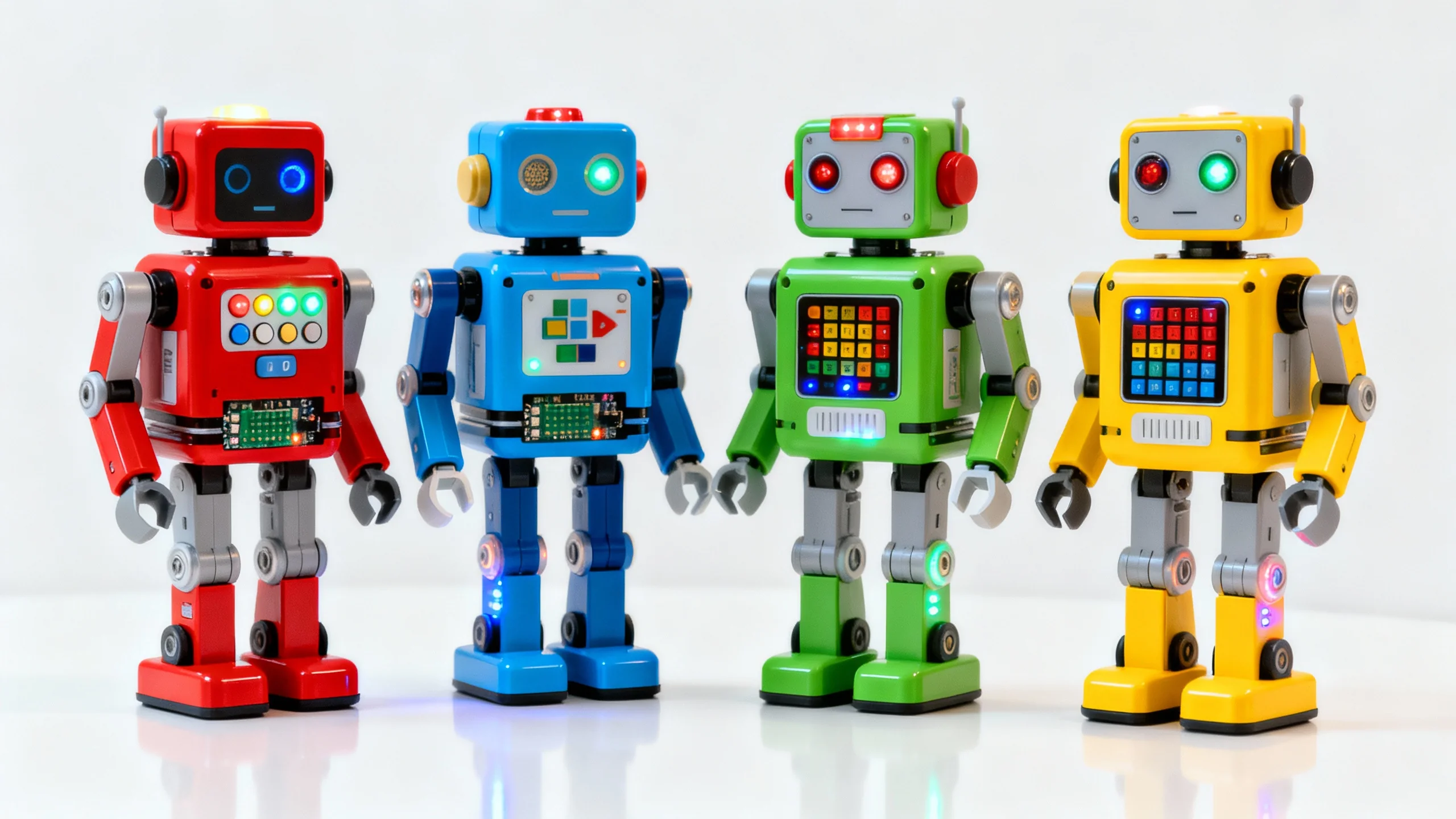
Most “robot” toys are battery-powered remote-control vehicles dressed as robots. The genuinely programmable robots — the ones that teach a child to write the code that controls behaviour — are a much smaller category. This guide picks the ones that actually program, age by age.
Lego Mindstorms / SPIKE Prime
The Lego Mindstorms (now Lego Education SPIKE Prime) line is the most-used educational robot in the world. Real sensors (touch, colour, distance), real motors, both block-based programming and Python support. Used in school robotics curricula and FIRST Lego League competitions. €350 is steep, but it’s the legitimate entry to engineering / programming as serious hobby.
| Robot Toys That Teach Code — at a glance | Notes | Age | Score |
|---|---|---|---|
| Lego Mindstorms / SPIKE Prime Editor's PickLego Education | Sensors, motors, real programming | 10+ | 94 |
| Lego BoostLego | Tablet-app, simpler | 7–12 | 90 |
| Sphero MiniSphero | Programmable rolling ball | 8+ | 88 |
| Bee-BotTTS Group | Pre-screen sequencing | 4–7 | 87 |
| Anki Vector / Cozmo (legacy) Personality pickDDL / Anki | AI personality, SDK | 8+ | 85 |
Frequently asked questions
Are robot toys actually teaching programming, or just remote-controlled toys?
What age can a child first use a programmable robot?
Is Mindstorms worth €350?
What happened to Cozmo and Anki?
Are there serious adult-hobby robots that scale up from kid robotics?
Our previous picks (preserved with affiliate links)
The list below is the original article we published earlier. The editorial bundle above represents our current analysis as of the last-reviewed date.
Why Coding Robots Matter for Young Learners
When we talk about robot toys that teach code, we’re really talking about tools that help kids think like scientists and engineers from the very start. The best coding robots aren’t just about screens and commands—they’re about active learning and discovery. Research shows that when children play with thoughtfully designed toys, they act much like scientists, experimenting and learning about cause and effect in a hands-on way. Developmental psychologist Alison Gopnik describes this process as “active learning,” where children naturally seek out toys that teach them the most, using them in ways that maximize their understanding of how things work [1].
What sets coding robots apart is their ability to turn abstract concepts into concrete, playful experiences. Kids get to see the immediate results of their logic and creativity, whether it’s making a robot follow a path, respond to commands, or solve a challenge. This kind of problem-solving is at the heart of STEM learning. It’s not just about memorizing code syntax—it’s about learning to break down problems, iterate, and try again when things don’t work the first time. As Steve Coxon, PhD, notes, overcoming failure and iterating on designs is a vital skill that robot toys uniquely foster, often more so than traditional classroom experiences [2].
A genuinely educational robot toy is one that’s open-ended and adaptable. The best options encourage kids to experiment, collaborate, and invent their own games or challenges. They’re not just following instructions—they’re creating, testing, and refining their own ideas. This flexibility is what makes a coding robot more than a one-time novelty. It becomes a platform for ongoing exploration, supporting creativity and logical thinking in equal measure [1].
We’ve found that the most effective coding robots are those that strike a balance between fun and challenge. They’re engaging enough to keep kids coming back, but also robust enough to grow with their skills. Whether your child is just starting to explore sequencing or ready to tackle more complex programming, the right robot can make learning feel like an adventure.
Worth checking out:
Inspiring Early Learning Bots
Top Coding Robot Picks for Every Age and Stage
Finding the right coding robot means considering your child’s age, interests, and curiosity level. We’ve sifted through expert reviews, educator feedback, and hands-on testing to highlight robots that truly stand out for different developmental stages.
For preschoolers and early elementary kids, simplicity and tactile engagement are key. The Fisher-Price Code ‘n Learn Kinderbot is a favorite for introducing basic coding concepts through buttons and light-up prompts. It’s designed for ages three to six and helps build problem-solving and sequencing skills without requiring reading or screen time [3]. Another standout is Botley the Coding Robot, which offers screen-free coding play and encourages kids to create their own obstacle courses and challenges. Botley’s intuitive interface and hands-on activities make it a great entry point for young learners [2].
As children move into elementary and middle school, they’re ready for more complexity and customization. The Makeblock mBot Robot Kit is a top pick for ages eight to twelve, offering a satisfying blend of building and programming. Kids can assemble the robot in about 15 minutes, then use block-based coding to make it follow lines, avoid obstacles, or even play music. What sets mBot apart is its expandability—it’s compatible with over 100 electronic modules and more than 500 parts, so kids can keep inventing new projects as their skills grow [2]. Wonder Workshop Dash is another excellent choice, blending personality with robust coding challenges. Dash responds to voice commands, navigates mazes, and can be programmed via a tablet app, making it a favorite in classrooms and homes alike [2].
For tweens and teens, advanced kits like LEGO Mindstorms and the Makeblock mBot2 open up even more possibilities. These robots support both block-based and text-based coding, allowing older kids to transition from visual programming to languages like Python. The modular design means kids can build custom robots, integrate sensors, and even explore artificial intelligence features. These kits are ideal for kids who want to dive deeper into robotics, engineering, and real-world problem-solving [2].
We also love options that blend robotics with storytelling and creativity. The Miko AI-Powered Smart Robot, for example, offers interactive games, jokes, and adaptive learning, making it a compelling companion for kids who enjoy both tech and imaginative play [2]. For animal lovers, the Thames & Kosmos My Robotic Pet: Coding Chameleon introduces coding through the lens of caring for a robotic pet, blending empathy with engineering.
Parents are loving these:
Best Bots for Every Age
Features That Make Coding Robots Engaging and Effective
Not all coding robots are created equal. The most engaging bots share a few key features that keep kids learning—and coming back for more.
Open-ended play is at the top of our list. The best robots don’t just walk through a set of pre-programmed routines; they invite kids to invent their own challenges, games, and solutions. This adaptability is crucial for fostering creativity and sustained interest. For example, the Makeblock mBot’s compatibility with a wide range of modules means it can evolve from a simple line-following bot to a complex, sensor-driven explorer as your child’s skills grow [2]. Similarly, Wonder Workshop Dash offers a suite of accessories and coding apps that unlock new capabilities over time, ensuring the robot stays fresh and exciting [2].
Durability and ease of setup are also essential. We’ve seen firsthand how a robot that’s tricky to assemble or prone to breaking quickly loses its appeal. The best picks are sturdy enough to withstand enthusiastic play and simple enough for kids (and parents) to get started without frustration. The mBot, for instance, can be assembled in about 15 minutes, and its robust construction holds up to repeated use [2]. For younger kids, robots like Botley and Kinderbot are designed with chunky, easy-to-handle parts that stand up to drops and bumps [3].
Another feature we value is ongoing interest. Robots that offer modular add-ons, app integrations, or expandable programming environments keep kids engaged as their skills develop. The LEGO Mindstorms and mBot ecosystems, for example, allow for endless customization and experimentation. Some robots even integrate with smart home devices or voice assistants, adding a layer of real-world relevance that older kids find especially motivating [2].
We also appreciate robots that blend physical and digital play. The Hex Bots Wall Crawler Gecko, for example, combines remote-controlled fun with a unique wall-climbing feature, sparking curiosity about physics and engineering in a playful way [5]. While not strictly a coding robot, it exemplifies how innovative design can make STEM concepts tangible and memorable.
Finally, accessibility matters. Robots that offer both screen-free and app-based coding options can meet kids where they are, supporting a range of learning styles and family preferences. Many of our top picks include step-by-step guides, online tutorials, and community forums, making it easier for parents to support their child’s learning journey.
Ready to shop?
Most Engaging Coding Bots
Tips for Choosing the Right Coding Robot for Your Child
Selecting the right coding robot is about more than just age recommendations—it’s about matching features to your child’s unique interests and learning style. Start by considering what excites your child most. Do they love building things from scratch, or are they more interested in storytelling and interactive play? Robots like mBot and LEGO Mindstorms are ideal for kids who enjoy engineering challenges and hands-on construction, while options like Miko or Botley may appeal to those who prefer games, puzzles, or imaginative scenarios [2].
Think about your child’s current skill level and how much support they’ll need to get started. Younger kids often benefit from screen-free robots with simple, tangible controls, while older children may be ready for app-based programming or even text-based coding. Look for robots that offer a clear progression path, so your child can advance at their own pace without outgrowing the toy too quickly [1].
Supporting learning at home can make a big difference. Many robot kits come with online resources, activity guides, and coding challenges to keep kids engaged. We recommend exploring community forums or local coding clubs, where kids can share projects and learn from peers. Some robots even offer integration with classroom curricula, making it easier to reinforce concepts learned at school [1].
Finally, consider scalability and long-term value. Robots that support modular add-ons or advanced programming languages can grow with your child, providing years of discovery and learning. Investing in a platform with a strong ecosystem—like Makeblock, LEGO, or Wonder Workshop—can open up a world of possibilities as your child’s interests evolve [2].
Here’s what we love:
Smart Choices for Every Family
Choosing a coding robot is about more than just technology—it’s about nurturing curiosity, confidence, and a lifelong love of learning. The right bot can turn everyday play into a launchpad for discovery, resilience, and creativity. We hope these insights help you find a robot that sparks wonder in your home and supports your child’s unique journey into the world of code.
Sources
[1] Learning Toys and STEM Toys We Love | Reviews by Wirecutter — https://www.nytimes.com/wirecutter/reviews/learning-toys-and-stem-toys-we-love/
[2] The Best Robot Toys for Kids According to Parents and Educators — https://www.parents.com/best-robot-toys-8583933
[3] Alexa, What Are The Best Robot Toys? — https://www.scarymommy.com/spotted/robot-toys
[4] I Almost Won My March Madness Pool Thanks to ChatGPT’s Bracket … — https://www.cnet.com/tech/services-and-software/i-almost-won-my-march-madness-pool-thanks-to-chatgpts-bracket-suggestions/
[5] This Robotic Lizard Climbs Walls and Is One of My Favorite Indoor … — https://www.cnet.com/culture/entertainment/this-robotic-lizard-climbs-walls-and-is-now-one-of-my-favorite-indoor-toys/