Microscope Gifts for Kids: Editorially Scored, Age by Age
Microscope gifts for kids — toy, beginner, intermediate, and serious-hobbyist tiers — editorially scored. With sample-prep notes and what each tier actually reveals.
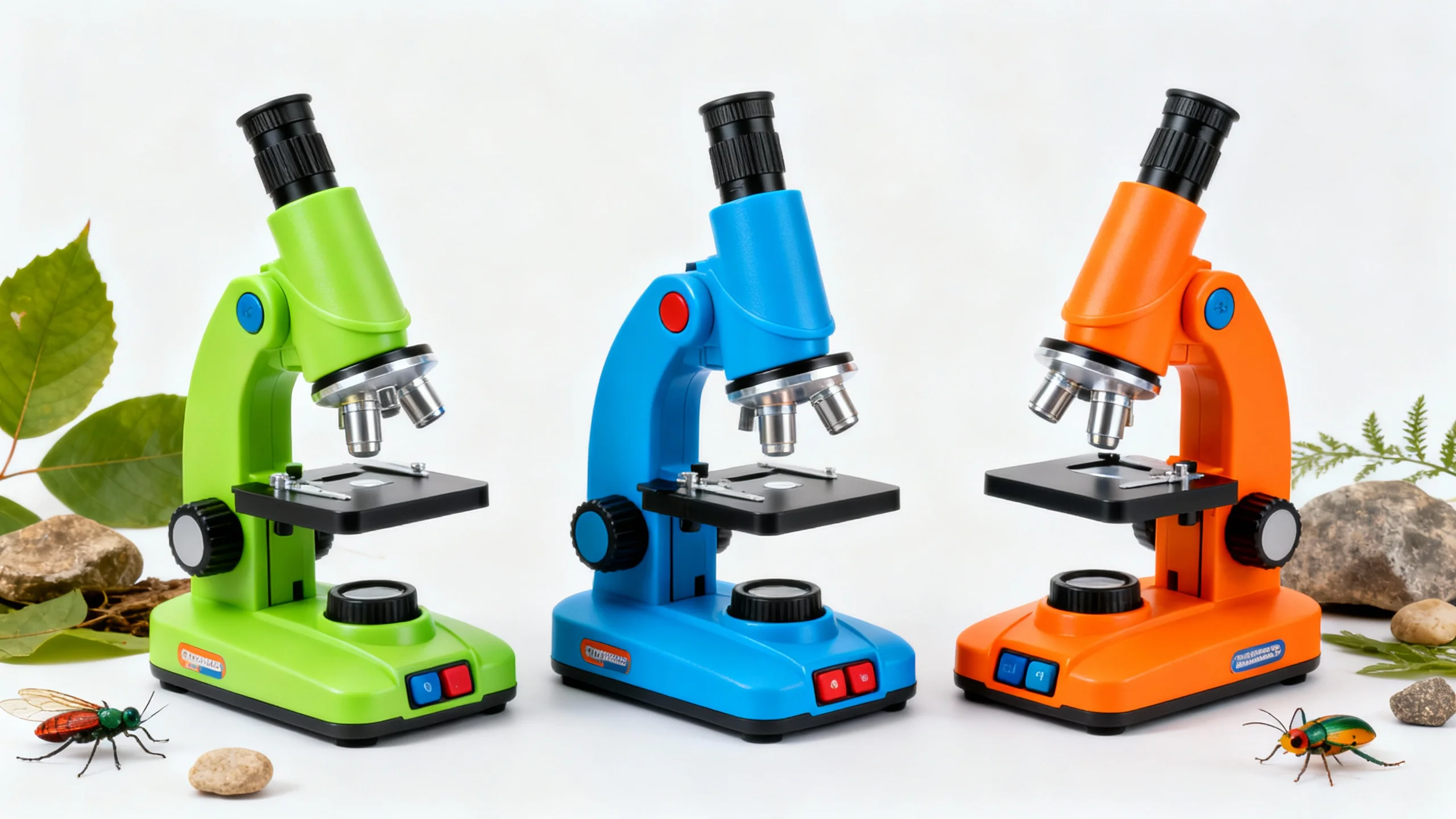
The microscope gift category has more bad buys than nearly any other STEM toy. The sub-€30 “educational microscope” market is full of plastic toys that show muddy 30× images of nothing recognisable, and a child who’s been disappointed by one rarely returns to the category. This guide separates the working microscopes from the disappointing ones, age by age.
My First Lab Duo-Scope
The My First Lab Duo-Scope is the only sub-€100 microscope we’ve found that genuinely works for kids 7+. Real glass optics (not plastic), proper sample stage, both top-light (for opaque objects like leaves and skin) and bottom-light (for prepared slides). Comes with prepared slides so the first session works without a parent prep-rabbit-hole. The runner-up is the Carson Pocket-Mini for €25 if you want to start very small.
| Microscope Gifts for Kids — at a glance | Notes | Age | Score |
|---|---|---|---|
| My First Lab Duo-Scope Editor's PickMy First Lab | 40×–400×, real glass optics | 7+ | 93 |
| Carson Pocket-Mini Microscope Best valueCarson | 60×–120×, pocket-size | 5+ | 88 |
| AmScope Beginner 40×–1000×AmScope | Lab-style, full-feature | 10+ | 90 |
| GeoSafari Constellation ExplorerEducational Insights | Plush-friendly, low-mag | 4–7 | 85 |
| Bresser Junior Bio TRBresser | 40×–600×, German-made | 8+ | 89 |
Frequently asked questions
What age can a child first use a microscope?
Why do cheap microscopes disappoint?
What's a good first-microscope sample to look at?
Are digital microscopes worth it?
What about a microscope as a STEM gift for an adult?
Our previous picks (preserved with affiliate links)
The list below is the original article we published earlier. The editorial bundle above represents our current analysis as of the last-reviewed date.
Early Explorers: Microscopes for Preschoolers and Young Kids
For the youngest scientists, the best microscope gifts are those that nurture curiosity and encourage hands-on exploration—without overwhelming little hands or short attention spans. At this stage, it’s all about introducing the concept of magnification and observation, not about technical precision. The right microscope for a preschooler is more of a science tool than a lab instrument, designed to withstand enthusiastic use and spark wonder at the tiniest details of the world.
Preschoolers thrive with simple, durable microscopes that offer large, easy-to-turn knobs and oversized eyepieces. Many models for this age group use plastic lenses and low magnification (typically 2x to 8x), which is perfect for viewing leaves, fabric, or even their own fingerprints. These microscopes often come in bright colors and chunky shapes, making them inviting and unintimidating for small children. Some even feature dual eyepieces or a single wide viewer, so kids don’t have to squint or struggle to align their eyes.
A key feature to look for is ease of use. Young children benefit from microscopes with fixed focus or simple, one-step focusing mechanisms. Battery-powered LED lights are a plus, as they illuminate objects without the need for fiddly mirrors. Many preschool microscopes double as magnifying viewers, allowing kids to examine rocks, bugs, or flowers both on and off the base. This flexibility encourages open-ended play, which research shows is essential for developing critical thinking and problem-solving skills [1].
We’ve seen that the most successful early microscopes are those that invite repeated, independent exploration. When a microscope is fun and frustration-free, kids are more likely to return to it again and again, building confidence and a genuine interest in science [2]. Some sets even include starter slides or specimen jars, giving children a sense of real scientific investigation while keeping things age-appropriate.
If you’re shopping for a preschooler, consider pairing a microscope with a simple nature collection kit or a set of large, easy-to-handle prepared slides. This combination can transform a walk in the park into a mini science expedition, making the invisible world suddenly accessible and exciting.
Here’s what we love:
Best First Microscopes
Budding Scientists: Elementary-Age Microscopes That Inspire Real Discovery
As children move into the elementary years, their scientific curiosity deepens and their dexterity improves. This is the perfect time to introduce microscopes that offer higher magnification and more authentic features, bridging the gap between playful exploration and real scientific observation. The best microscopes for this age group are robust, user-friendly, and capable of revealing the hidden details of everyday objects—without requiring a PhD to operate.
Elementary-age kids are ready for compound microscopes with magnification levels ranging from 40x to 400x. These instruments allow them to examine prepared slides, pond water, onion skin, or even their own cheek cells. Look for models with sturdy construction, clear glass optics, and coarse and fine focus knobs. A built-in LED light source is essential for illuminating transparent specimens, while a rotating turret with multiple objective lenses lets kids experiment with different levels of detail.
One of the most important factors at this stage is engagement. Kids are more likely to use a microscope regularly if it comes with a set of prepared slides, blank slides for their own discoveries, and a well-written activity guide. Kits that include tweezers, pipettes, and specimen jars encourage hands-on investigation and help children feel like real scientists. According to educators and science museum experts, open-ended tools that invite experimentation are the most effective at fostering lifelong learning [1].
We’ve found that children in this age group are fascinated by the process of preparing their own slides—whether it’s a drop of pond water, a sliver of plant stem, or a bit of hair. The act of collecting, preparing, and observing specimens builds fine motor skills and reinforces the scientific method: ask a question, make a prediction, observe, and draw conclusions. Some microscopes even connect to tablets or computers, allowing kids to capture and share their discoveries, which can be a powerful motivator for continued exploration.
When choosing a microscope for an elementary-age child, prioritize models that balance durability with optical quality. Plastic lenses are fine for younger kids, but glass optics provide a clearer, more satisfying view for older children. Adjustable eyepieces and comfortable viewing angles make longer observation sessions more enjoyable. And don’t underestimate the value of a well-designed instruction manual—clear, engaging explanations can make all the difference in transforming a microscope from a toy into a true learning tool.
Parents are loving these:
Inspiring Science Tools
Confident Investigators: Advanced Microscopes for Tweens and Teens
By the time kids reach the tween and early teen years, their scientific interests often become more focused and sophisticated. At this stage, a microscope is more than just a toy—it’s a gateway to real scientific inquiry. The best gifts for this age group are laboratory-quality microscopes that deliver crisp, detailed images and support a wide range of experiments, from biology to forensics.
Tweens and teens are ready for full-featured compound microscopes with magnification up to 1000x or more. These instruments typically include multiple objective lenses, fine and coarse focus controls, and high-quality glass optics. A mechanical stage (which allows precise movement of slides) and a built-in LED or halogen light source are essential for serious observation. Some advanced models even offer digital cameras or smartphone adapters, enabling students to document and share their findings.
At this level, kids can explore everything from cellular structures to microorganisms in pond water, and even begin to conduct their own experiments. Many science kits for this age group include advanced prepared slides (such as plant and animal tissues), blank slides for custom specimens, and detailed experiment guides. These resources support deeper learning and encourage kids to ask their own questions, design experiments, and interpret results—skills that are central to real science [3].
We’ve noticed that tweens and teens are especially motivated by microscopes that feel “real”—solid, precise, and capable of producing professional-quality results. This sense of authenticity can be the spark that transforms a passing interest into a lifelong passion for science. According to recent reviews and parent feedback, the best microscopes for this age group are those that balance affordability with performance, offering features found in classroom or lab settings without being prohibitively expensive [2].
When shopping for an advanced microscope, consider the types of experiments your child is interested in. Some models are optimized for biological specimens, while others can handle mineral or crystal samples. Accessories like polarizing filters, phase contrast kits, or digital imaging modules can expand the possibilities even further. And don’t forget about supporting materials—a well-written experiment book or access to online tutorials can help kids get the most out of their microscope.
Worth checking out:
Advanced Science Gear
Beyond the Lens: Science Kits and Accessories to Deepen the Experience
A microscope is a powerful tool on its own, but the experience becomes truly transformative when paired with the right science kits and accessories. These extras can turn a microscope from a single-purpose gift into the centerpiece of a home laboratory, supporting a wide range of experiments and discoveries across biology, chemistry, and even earth science.
For younger children, consider kits that include prepared slides featuring plant cells, insect wings, or textile fibers. These ready-to-go specimens provide instant gratification and help kids learn how to use their microscope without the frustration of tricky sample preparation. As children grow, blank slides, cover slips, and simple staining kits allow them to create their own specimens, fostering independence and creativity.
Many science kits go beyond slides, offering materials for experiments that complement microscope use. For example, a butterfly garden kit lets kids observe the life cycle of caterpillars up close, while a pond water collection set encourages outdoor exploration and the discovery of microscopic life [3]. Chemistry kits with safe, age-appropriate experiments can introduce concepts like crystallization or osmosis, which are fascinating to observe under magnification.
Accessories like specimen jars, tweezers, pipettes, and petri dishes make it easier for kids to collect and prepare samples. For older children and teens, more advanced tools—such as microtomes for slicing thin sections, or digital cameras for capturing images—can open up new avenues for investigation and documentation. Some families even invest in books or online courses that teach microscopy techniques and experimental design, providing a structured path for deeper learning.
We’ve found that the most engaging science experiences are those that connect the microscope to the wider world. Whether it’s examining the structure of a leaf, identifying minerals, or investigating the microbes in a drop of pond water, these activities encourage kids to see themselves as real scientists—curious, capable, and empowered to explore. According to developmental research, this kind of active, hands-on learning is what truly inspires a lifelong love of science [1].
If you’re looking to build a home science lab, start with a few high-quality accessories and a well-chosen kit or two. Over time, you can expand your collection based on your child’s interests, creating a rich environment for discovery that grows with them.
Ready to shop?
Science Kit Essentials
A thoughtfully chosen microscope gift can open up a universe of discovery for kids at any age. By matching the right tool to your child’s stage and interests—and supporting it with engaging kits and accessories—you’re not just giving a present, you’re nurturing a scientist. Here’s to many years of wonder, exploration, and real science at home.
Sources
[1] Learning Toys and STEM Toys We Love | Reviews by Wirecutter — https://www.nytimes.com/wirecutter/reviews/learning-toys-and-stem-toys-we-love/
[2] 23 Best STEM Toys of 2025, Tested With Kids and Parents — https://www.goodhousekeeping.com/childrens-products/g5162/best-stem-toys/
[3] Best science kits for kids of all ages | MadeForMums — https://www.madeformums.com/reviews/best-science-toy/
[4] 36 Best Gifts for 4-Year-Olds 2025 | The Strategist — https://nymag.com/strategist/article/best-toys-gifts-for-4-year-old-boys-girls.html
[5] As a Mom & a Teacher, I’m Shopping These Early Black Friday … — https://www.parents.com/best-black-friday-toy-deals-under-50-2024-8747408