
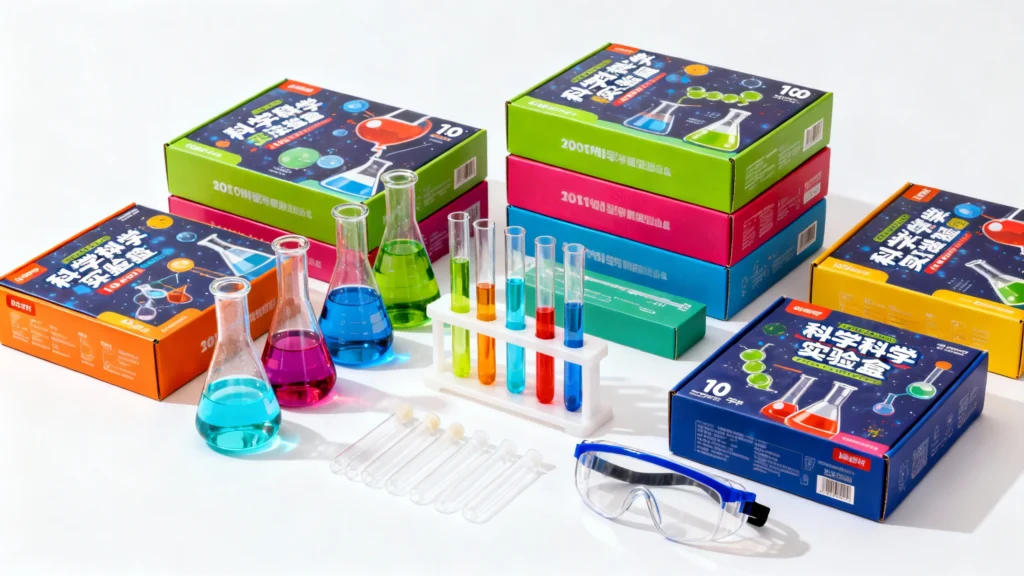
Science Kits That Make Experiments Exciting
Ten-year-olds are at a wonderful crossroads: their curiosity is matched by growing independence and the ability to tackle more complex projects. The right science kit can transform a kitchen table into a laboratory, inviting kids to explore chemistry, physics, biology, and more. At this age, kits that offer a variety of experiments—rather than just one or two—tend to keep interest high and encourage repeated use. We’ve found that kits with clear instructions, real scientific tools, and opportunities for open-ended exploration are especially engaging for budding experimenters.
A great science kit doesn’t just walk kids through a series of steps; it encourages them to ask questions, make predictions, and tweak variables to see what happens. For example, the Horrible Science Chaotic Kitchen Experiments kit lets kids power a clock with a potato, write secret messages, and create kitchen concoctions that fizz, pop, and even smell a bit wild—all while learning about chemical reactions and the scientific method [5]. Kits like these are designed to be hands-on and a little bit messy, which is exactly what makes them memorable.
For kids who love biology, the Insect Lore Butterfly Garden is a perennial favorite. Watching caterpillars transform into butterflies is a powerful lesson in life cycles and patience, and it’s an experiment that unfolds over days and weeks, not just minutes [5]. Meanwhile, the Science 4 You Green Science Kit introduces eco-friendly experiments that teach about renewable energy, recycling, and the environment—perfect for kids who are passionate about the planet [5].
We also love kits that encourage kids to keep a science journal, recording their hypotheses, observations, and results. This practice not only builds scientific thinking but also helps kids see themselves as real scientists, capable of making discoveries and drawing conclusions [3]. Safety is always a priority, so look for kits that include goggles, gloves, or aprons, and be sure to supervise experiments that involve heat, chemicals, or sharp tools.
Here’s what we love:
Best Experiment Kits
Tools and Gadgets for Young Investigators
As kids grow, their desire to understand how things work often leads them to crave real tools and gadgets. At age 10, many are ready to move beyond plastic toys and start using equipment that feels authentic—think microscopes, telescopes, and simple electronics kits. These tools not only make experiments more exciting but also help kids develop fine motor skills, patience, and attention to detail.
A microscope opens up a hidden world, letting kids examine leaves, pond water, or even the structure of a feather. The Science Mad 100X Microscope is designed for beginners but offers enough magnification to reveal fascinating details [5]. For those who look to the stars, a child-friendly telescope like My First Telescope is lightweight, easy to use, and can spark a lifelong interest in astronomy [5]. Both tools encourage observation, note-taking, and a sense of wonder about the natural world.
Electronics kits are another fantastic option for young experimenters. Kits that let kids build circuits, alarms, or even simple robots teach the basics of electricity and engineering in a hands-on way. Many sets are modular, so kids can experiment with different configurations and see immediate results from their tinkering [1]. These experiences build confidence and introduce concepts like coding, logic, and troubleshooting.
Don’t overlook classic gadgets like magnifying glasses, pH test strips, or even a simple kitchen scale. These tools can be used in countless home experiments, from testing the acidity of household liquids to measuring the mass of everyday objects. The key is to choose gadgets that are sturdy, easy to use, and versatile enough to inspire many different investigations.
Worth checking out:
Young Scientist Tools
Creative Building Sets and Open-Ended Projects
Experimentation isn’t limited to test tubes and beakers. Building sets and open-ended project kits invite kids to design, construct, and iterate—skills that are at the heart of engineering and invention. At age 10, kids are ready for sets that challenge their spatial reasoning, problem-solving, and creativity.
LEGO remains a favorite, but there’s a world of options beyond the classic bricks. Sets that incorporate gears, motors, or programmable elements add layers of complexity and excitement. For example, robotics kits let kids build moving creations and experiment with basic coding, while marble runs and chain-reaction sets encourage kids to design and test their own contraptions [1]. These toys are open-ended, meaning there’s no single “right” way to play—kids can invent, modify, and rebuild as often as they like.
Nanoblock sets, which use tiny pieces to create intricate models, are another hit with this age group [2]. They require patience and precision, and the finished products are display-worthy. For kids who love a challenge, look for sets that combine building with experimentation, such as kits that let them construct bridges and test their strength, or design vehicles and race them to see which is fastest.
Tinkering kits that include a mix of materials—wood, plastic, metal, and even recycled items—encourage kids to invent their own projects from scratch. These kits often come with idea books but leave plenty of room for kids to dream up their own experiments. The process of designing, building, testing, and refining is deeply satisfying and teaches resilience as well as creativity [1].
Parents are loving these:
Best Building Sets
Books and Journals to Fuel Curiosity
A love of experiments is often fueled by great books—the kind that explain scientific concepts in clear, engaging language and offer ideas for hands-on activities. At age 10, kids are ready for books that go beyond the basics, introducing them to real-world science, famous experiments, and the stories of inventors and explorers.
Look for books that include step-by-step experiments, explanations of the underlying science, and prompts for further investigation. Titles that encourage kids to keep a science journal are especially valuable, as they help kids develop the habit of recording observations, forming hypotheses, and reflecting on results [3]. This practice not only builds scientific thinking but also supports writing and organizational skills.
Journals designed for young scientists often include prompts, experiment templates, and space for sketches and notes. Some even come with stickers or pockets for collecting samples. Encouraging kids to document their experiments helps them see patterns, track progress, and develop a sense of ownership over their learning.
Biographies of scientists, inventors, and explorers can also inspire kids to see themselves as part of a larger tradition of curiosity and discovery. Stories about real people who asked big questions, made mistakes, and persevered can be just as motivating as any experiment kit.
Finally, don’t forget the value of reference books—encyclopedias, field guides, and illustrated atlases that kids can turn to when they have questions or want to dig deeper into a topic. These resources support independent learning and help kids connect their experiments to the wider world.
Ready to shop?
Inspiring Science Reads
Curious, thoughtful gifts can transform a ten-year-old’s love of experiments into a lifelong passion for discovery. Whether you choose a hands-on kit, a real scientific tool, a creative building set, or a book that sparks new questions, you’re giving more than just a present—you’re opening doors to wonder, confidence, and real-world skills. Here’s to many joyful, messy, and mind-expanding experiments ahead.
Sources
[1] Learning Toys and STEM Toys We Love | Reviews by Wirecutter — https://www.nytimes.com/wirecutter/reviews/learning-toys-and-stem-toys-we-love/
[2] 43 Best Gifts for 10-Year-Olds 2025 | The Strategist — https://nymag.com/strategist/article/best-gifts-toys-games-for-10-year-olds.html
[3] 45 Best Science Experiments for Kids to Do at Home or In School — https://www.goodhousekeeping.com/life/parenting/g32176446/science-experiments-for-kids/
[4] Birthday Cartoons To Watch With Your Kid On Their Special Day — https://parentingpatch.com/best-birthday-cartoons-to-watch-with-your-kid/
[5] Best science kits for kids of all ages | MadeForMums — https://www.madeformums.com/reviews/best-science-toy/