
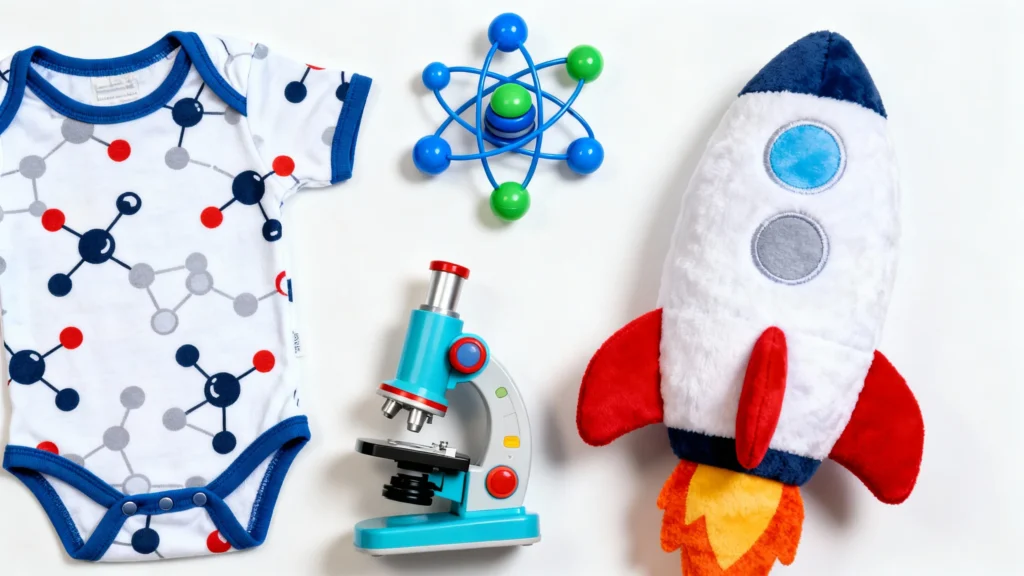
Open-Ended Toys That Encourage Scientific Thinking
When it comes to nurturing a budding scientist, open-ended toys are a powerful place to start. These toys don’t just entertain—they invite babies and toddlers to experiment, problem-solve, and create, all while having fun. Research shows that children naturally approach play like scientists, testing ideas and learning about the world through hands-on exploration. Developmental psychologist Alison Gopnik describes how even preschoolers gravitate toward toys that teach them the most, playing in ways that maximize their learning about how things work [1].
For science-loving families, the best toys are those that adapt to a child’s interests and abilities over time. Think of toys that can be used in multiple ways, encourage cause-and-effect exploration, and foster skills like logic and collaboration. For babies and toddlers, this might mean stacking cups that double as bath toys, or shape sorters that introduce early concepts of classification and geometry. As children grow, toys like marble runs, magnetic tiles, and simple coding robots offer new challenges and opportunities for discovery.
We’re especially drawn to toys that don’t dictate a single way to play. Instead, they invite children to ask questions: What happens if I stack these blocks differently? Can I make the ball go faster? How do these pieces fit together? This kind of active learning is the foundation of scientific thinking, and it’s just as valuable for a one-year-old as it is for an older child [1].
Durability and safety matter, too. Look for toys made from high-quality materials that can withstand enthusiastic play and repeated experiments. Many of our favorite picks are also easy to clean and designed for little hands, making them practical for everyday use.
Here’s what we love:
Best Science Play Starters
Books and Magazines for Early Curiosity
Reading together is one of the most joyful ways to introduce scientific ideas from the very beginning. Babies may not understand every word, but they absorb so much from the rhythm of language, the colors of illustrations, and the excitement in your voice. For science-loving families, board books and picture books about space, animals, weather, and the natural world are a wonderful way to spark early curiosity.
We’re big fans of books that blend simple storytelling with real scientific concepts. Titles that explore the solar system, introduce basic physics, or celebrate the diversity of life on Earth can become bedtime favorites. As your child grows, you can add more detailed books that encourage questions and invite discussion. The best children’s books are those that grow with your family, offering new layers of meaning as your child’s understanding deepens [4].
Magazines are another fantastic resource, especially for families who want to nurture a love of reading and discovery. Even babies can enjoy flipping through sturdy, beautifully illustrated magazines like Babybug, which is designed for the tiniest hands and minds [2]. As children get older, subscriptions to science-focused magazines such as Ranger Rick or Oyla Junior provide a steady stream of new ideas, experiments, and stories to explore together. The tactile experience of receiving mail, turning pages, and discovering new topics is a delight that screens just can’t replicate [2].
Books and magazines also make thoughtful gifts for families who value screen-free learning and want to build a home library that inspires wonder. They’re easy to share, easy to revisit, and perfect for cozy moments together.
Parents are loving these:
Inspiring Science Reads
Hands-On Kits and Experiments for Little Explorers
There’s something magical about watching a child’s eyes light up when they see a chemical reaction, a floating object, or a simple machine in action. Hands-on science kits and experiment sets are a fantastic way to channel that sense of wonder into real learning. For babies and toddlers, the best kits focus on sensory exploration—think water play, color mixing, or safe, edible “experiments” that let little ones squish, pour, and observe.
As children move into the preschool years, you can introduce more structured activities that encourage them to make predictions, test ideas, and record what they see. Even very young children can start learning the basics of the scientific method: asking questions, making observations, and drawing conclusions. Simple experiments with household items—like floating and sinking, color mixing, or growing seeds—are not only fun, but also build foundational skills for later STEM learning [3].
We love kits that come with clear instructions, durable materials, and plenty of room for open-ended play. Look for sets that include safe tools like magnifying glasses, droppers, and measuring cups, as well as guides for parents to help scaffold the experience. The best kits encourage kids to get a little messy, ask “what if,” and celebrate both successes and surprises.
For families who want to go beyond the box, there are endless possibilities for DIY science at home. Everyday objects—like dry erase markers, eggs, and water—can become the basis for fascinating experiments that teach about density, solubility, and chemical reactions [3]. The key is to create an environment where curiosity is encouraged, and where it’s okay to make mistakes and try again.
Ready to shop?
Little Scientist Kits
Building Sets That Grow with Your Child
Few gifts are as enduring—or as beloved by science-minded families—as a great building set. From the earliest days, babies are fascinated by stacking, knocking down, and rebuilding. As they grow, building toys evolve into tools for exploring engineering, architecture, and even basic physics. The best sets are those that offer open-ended possibilities, allowing children to invent, experiment, and create without limits [5].
For infants and toddlers, chunky blocks made from wood or soft materials are perfect for developing fine motor skills and hand-eye coordination. As your child’s abilities expand, magnetic tiles, interlocking bricks, and more complex construction sets introduce new challenges and opportunities for imaginative play. These toys encourage children to think spatially, plan ahead, and solve problems—skills that are at the heart of scientific thinking [1,5].
We especially appreciate building sets that can be used in new ways as your child grows. Magnetic tiles, for example, can start as simple stacking toys and later become the foundation for elaborate structures, vehicles, or even basic circuits. Sets that include wheels, gears, or ramps add an extra layer of experimentation, inviting kids to explore concepts like gravity, momentum, and balance.
Building together is also a wonderful way for families to connect. Whether you’re working side by side on a tower or collaborating on a marble run, these moments of shared discovery are the building blocks of lifelong curiosity.
Worth checking out:
Best Building Sets
Choosing a gift for a baby boy in a science-loving family is about so much more than the present itself—it’s about nurturing curiosity, inviting questions, and celebrating discovery together. Whether you choose a thoughtfully designed toy, a beautiful book, or a hands-on kit, you’re helping to lay the foundation for a lifetime of joyful learning. Here’s to raising the next generation of explorers, inventors, and wonder-seekers—one inspired gift at a time.
Sources
[1] Learning Toys and STEM Toys We Love | Reviews by Wirecutter — https://www.nytimes.com/wirecutter/reviews/learning-toys-and-stem-toys-we-love/
[2] Our 12 Favorite Kids Magazine Subscriptions | Reviews by Wirecutter — https://www.nytimes.com/wirecutter/reviews/kids-magazine-subscriptions/
[3] 45 Best Science Experiments for Kids to Do at Home or In School — https://www.goodhousekeeping.com/life/parenting/g32176446/science-experiments-for-kids/
[4] 25 Best Children’s Books Gift Ideas | The Strategist — https://nymag.com/strategist/article/best-childrens-books-gift-ideas.html
[5] These Are the Building Toys My Family Loves Most — https://nymag.com/strategist/2024/09/favorite-building-toys.html