
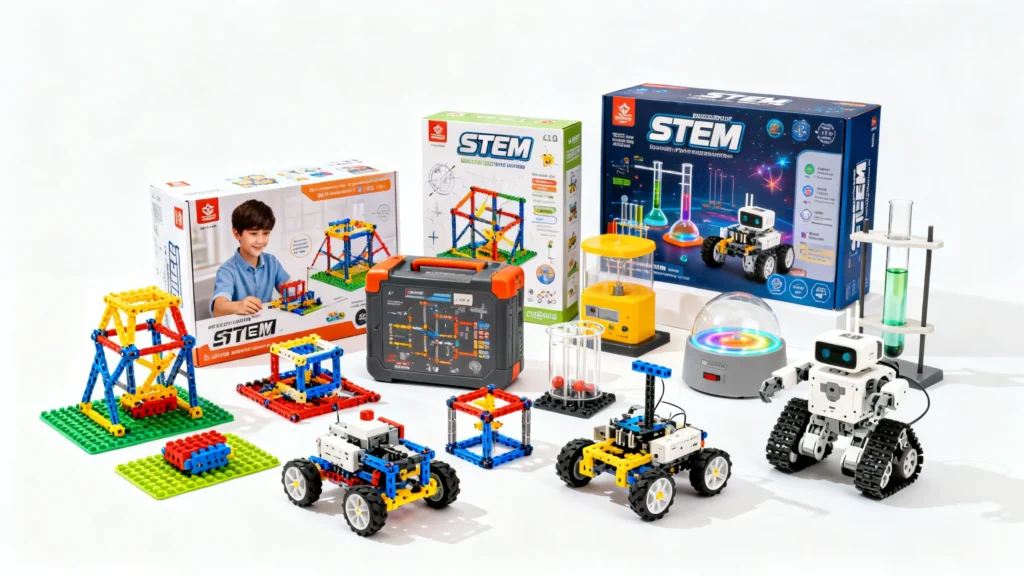
The Science Behind STEM Toys: Why Early Play Matters
When we talk about STEM toys, we’re really talking about tools for discovery. Decades of research show that children learn best through play, especially when their toys invite them to experiment, build, and imagine. Developmental psychologist Alison Gopnik describes how, during play, children act much like scientists—testing, observing, and drawing conclusions about how the world works [1]. This kind of active learning is not just fun; it’s essential for developing critical thinking and problem-solving skills that last a lifetime.
What sets STEM toys apart is their focus on open-ended exploration. Unlike toys that have a single “right” answer or outcome, the best STEM toys encourage kids to ask questions, try new ideas, and learn from mistakes. This process mirrors the scientific method and helps children build confidence in their ability to figure things out. In fact, studies show that kids are naturally drawn to toys that challenge them and provide opportunities for learning [1].
It’s important to note that not every toy labeled “educational” truly supports learning. The most effective STEM toys are those that are adaptive, flexible, and provoke curiosity—qualities that keep children engaged and coming back for more [1]. When kids are given the freedom to tinker, build, and create, they develop not only cognitive skills but also creativity, collaboration, and resilience.
The benefits of STEM play start early. Even babies and toddlers can begin developing fine motor skills, spatial reasoning, and cause-and-effect understanding through simple stacking, sorting, and building activities [4]. As children grow, more complex toys introduce concepts like sequencing, coding, and engineering in ways that feel like pure play. The key is to match the toy to your child’s developmental stage and interests, ensuring that learning remains joyful and meaningful.
Here’s what we love:
Science-Backed Early Play
Choosing the Right STEM Toys for Every Age and Stage
Selecting the right STEM toy is less about chasing trends and more about understanding your child’s unique needs and interests. The best toys for babies are those that stimulate the senses and encourage exploration through touch, sight, and sound. Simple shape sorters, stacking rings, and activity boards help little ones develop hand-eye coordination and early problem-solving skills [4].
For toddlers and preschoolers, look for toys that introduce basic concepts in math, science, and engineering through hands-on play. Magnetic tiles, building blocks, and interactive activity wagons are excellent choices because they allow for open-ended construction and experimentation [4]. These toys foster spatial reasoning and introduce children to the principles of balance, symmetry, and cause-and-effect.
As children move into the early elementary years, their ability to think abstractly and solve more complex problems grows. This is a great time to introduce toys that involve sequencing, logic, and basic coding. Games that require planning, marble runs, and beginner robotics kits can keep kids engaged while building essential skills [1][3]. The most successful toys at this stage are those that adapt to a child’s growing abilities, offering new challenges as they master old ones.
For older kids, look for kits and games that encourage experimentation and creativity. Electronics sets, advanced construction kits, and science experiment boxes allow children to dive deeper into topics like circuitry, chemistry, and engineering [3][4]. The goal is to provide opportunities for real-world problem-solving and to nurture a sense of wonder about how things work.
It’s also worth considering the durability and replay value of a toy. The best STEM toys are those that withstand repeated use and inspire new discoveries each time they’re played with [1]. Seek out toys that grow with your child, offering layers of complexity and opportunities for collaborative play with siblings or friends.
Parents are loving these:
Age-Perfect STEM Picks
Our Favorite Science-Backed STEM Toys for Babies and Kids
With so many options on the market, it can be overwhelming to choose the right STEM toys for your family. We’ve sifted through expert reviews, parent feedback, and real-world testing to highlight toys that consistently deliver on both fun and learning.
For babies and toddlers, the LeapFrog Learning Hamburger stands out for its clever design that teaches sequencing, shapes, and colors while encouraging fine motor skills [4]. Parents report that their little ones love assembling the “ingredients” and watching them spin down, turning snack time into a playful lesson in logic and order. Similarly, the VTech Sort & Discover Activity Wagon offers a multi-sensory experience, combining shape sorting, color recognition, and gross motor play in a single, engaging package [4].
Magnetic construction sets like Magna-Tiles and Blockaroo Magnetic Foam Blocks are perennial favorites for preschoolers and beyond. These toys introduce concepts like magnetism, symmetry, and spatial reasoning while allowing for endless creative possibilities [4]. Because they’re open-ended, kids can build everything from simple towers to elaborate bridges and robots, developing both engineering skills and imagination.
For children ready to explore more complex ideas, marble runs and wind play labs offer hands-on lessons in physics and engineering. The Ravensburger GraviTrax Junior Jungle set, for example, lets kids design their own marble mazes, experimenting with gravity, momentum, and cause-and-effect [4]. Kits like the KiwiCo Wind Play Lab add a sensory twist, inviting kids to explore how wind can make objects spin and fly—a playful introduction to aerodynamics and energy [4].
Coding and robotics toys are also making STEM learning more accessible than ever. Beginner-friendly robots and circuit kits introduce children to logic, sequencing, and basic programming in ways that feel like pure play [1][3]. These toys encourage kids to think like engineers, breaking down big problems into manageable steps and celebrating each small success along the way.
We also love toys that blend science with art, such as 3Doodler pens and creative building sets. These options invite kids to experiment with design, structure, and technology, proving that STEM and creativity go hand in hand [2][5]. The best part? Many of these toys are just as fun for parents, making them perfect for family play and collaborative discovery.
Worth checking out:
Standout STEM Favorites
Everyday STEM: Encouraging Exploration Beyond the Toy Box
STEM learning doesn’t stop when the toys are put away. In fact, some of the most memorable discoveries happen during everyday activities. Simple experiments—like building a juice-pouch stomp rocket or a pom-pom catapult—turn household items into launchpads for curiosity [5]. These hands-on projects teach kids about physics, engineering, and problem-solving, all while fueling their natural sense of wonder.
Cooking together is another fantastic way to explore math and science concepts. Measuring ingredients, observing chemical reactions, and experimenting with flavors all provide opportunities for learning in a real-world context. Gardening, too, introduces children to biology, ecology, and the cycles of nature, fostering a lifelong appreciation for the environment.
Encouraging your child to ask questions, make predictions, and test their ideas is at the heart of everyday STEM. Whether you’re exploring the backyard, building a fort, or troubleshooting a broken toy, you’re helping your child develop the skills and mindset of a scientist. The key is to create an environment where curiosity is celebrated and mistakes are seen as opportunities to learn.
Books, documentaries, and visits to science museums can also spark new interests and deepen understanding. Many families find that combining hands-on play with real-world experiences helps children make connections between what they learn and the world around them [1]. The most important thing is to stay engaged, follow your child’s lead, and enjoy the journey of discovery together.
Ready to shop?
Everyday STEM Essentials
Choosing STEM toys and activities is about more than just keeping kids busy—it’s about nurturing curiosity, creativity, and a lifelong love of learning. By offering thoughtfully chosen toys and encouraging everyday exploration, we can help our children grow into confident, capable problem-solvers ready to take on the world.
Sources
[1] Learning Toys and STEM Toys We Love | Reviews by Wirecutter — https://www.nytimes.com/wirecutter/reviews/learning-toys-and-stem-toys-we-love/
[2] 2025 STEM 10 Toys | The Toy Insider — https://thetoyinsider.com/products_category/stem-10/
[3] 33 Best STEM Toys for Kids | The Strategist — https://nymag.com/strategist/article/best-stem-toys-for-kids.html
[4] 23 Best STEM Toys of 2025, Tested With Kids and Parents — https://www.goodhousekeeping.com/childrens-products/g5162/best-stem-toys/
[5] 23 Fun STEAM and STEM Activities for Kids — https://www.parents.com/kids/education/math-and-science/5-fun-stem-crafts-for-kids/